
Table of Contents
//Removing a tie seems like a minor decision until the shirt collar disappears beneath the jacket or opens in a way that feels unfinished. The rest of the clothes may be perfectly suitable, yet the area around the face looks unresolved. An open collar has its own set of relationships, and simply subtracting neckwear does not settle them.
A convincing open-collar outfit depends on how the shirt, jacket, and wearer work together. The desired mood can range from relaxed business dress to an informal evening look. There is no single collar shape that solves every version. The useful approach is to test the complete combination and understand which details influence its character.
Start with the Jacket You Will Actually Wear
The jacket sets part of the frame. Its lapels, opening, and overall structure affect how much of the shirt is visible and how formal the combination feels. A collar that looks appealing on its own may become less convincing beneath a particular jacket. Bringing the two together early prevents a decision based on an incomplete view.
Try the shirt with the jacket both fastened and open, as appropriate to how it will be worn. Observe whether the collar sits comfortably and whether its points remain where you want them during ordinary movement. Rather than relying on a universal rule about where every collar must sit, judge the effect within that outfit.
The neckline should also suit the setting. A restaurant evening and a conservative client meeting may call for different degrees of openness. Check the result while standing and seated; fabric can shift as posture changes. The right choice is the one that feels deliberate without requiring constant attention.
Discuss Structure as Well as Collar Shape
Collar labels offer a starting vocabulary, but the name alone does not describe the entire experience. The amount of support, the way the collar folds, and the fabric around it all contribute to the result. Ask to see finished examples rather than choosing solely from a diagram or a close-up photograph.
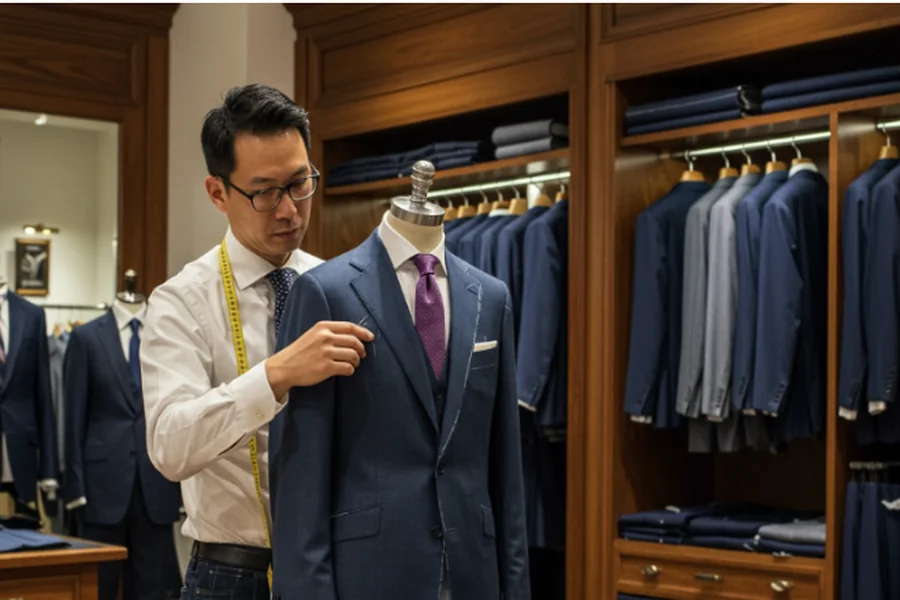
For anyone considering tailored shirts in Bangkok, a useful request is to see how a proposed collar behaves without a tie and beneath the intended jacket. Explain whether the shirt will sometimes be worn with neckwear as well. A shirt designed for both situations involves choices that should be discussed rather than assumed.
Comfort remains essential even when the top button is open. The collar should not create an irritating pressure point, and the shirt should allow normal head movement. Report what you feel during the fitting. Visual neatness is only part of the judgment when the garment will be worn for an entire working day.
Keep the Shirt Front Under Control
Once the tie is removed, the shirt front becomes more visible. Excess fabric, strain near the buttons, or an untidy tuck can attract attention that previously went elsewhere. Look at the torso as a whole rather than concentrating only on the collar. A shirt that is extremely close to the body is not automatically the cleanest option.
Sit, reach, and stand again. Notice whether the front pulls open or whether the shirt repeatedly escapes the waistband. Explain those observations to the fitter without assuming that every issue requires reducing or adding width in the same place. The appropriate adjustment depends on the garment and the wearer.
If an undershirt is part of the usual outfit, wear it during the trial. Its neckline, color, and thickness can affect the visible result. The goal is to assess the clothes as they will be used, not under unusually favorable conditions that cannot be repeated on an ordinary morning.
Use Color and Texture to Set the Mood
A plain light shirt beneath a dark jacket gives a different impression from a textured shirt beneath a casual layer. Neither needs a tie to appear intentional, but the surrounding choices should support the level of formality. Shoes, trousers, and the condition of the clothing matter as much as the unbuttoned neckline.
Patterns can add interest, although a busy shirt may compete with a strongly patterned jacket. View the combination from a conversational distance rather than inspecting each cloth separately. If the eye has nowhere to settle, simplify one element. A quieter shirt often gives the jacket more room, while a plain jacket can accommodate a more expressive shirt.
Make the final decision after moving around for a few minutes. An open collar that needs continuous rearranging is unlikely to become easier during dinner or a meeting. When the shirt sits comfortably and the surrounding pieces agree, the absence of a tie feels like a considered choice rather than a missing component.